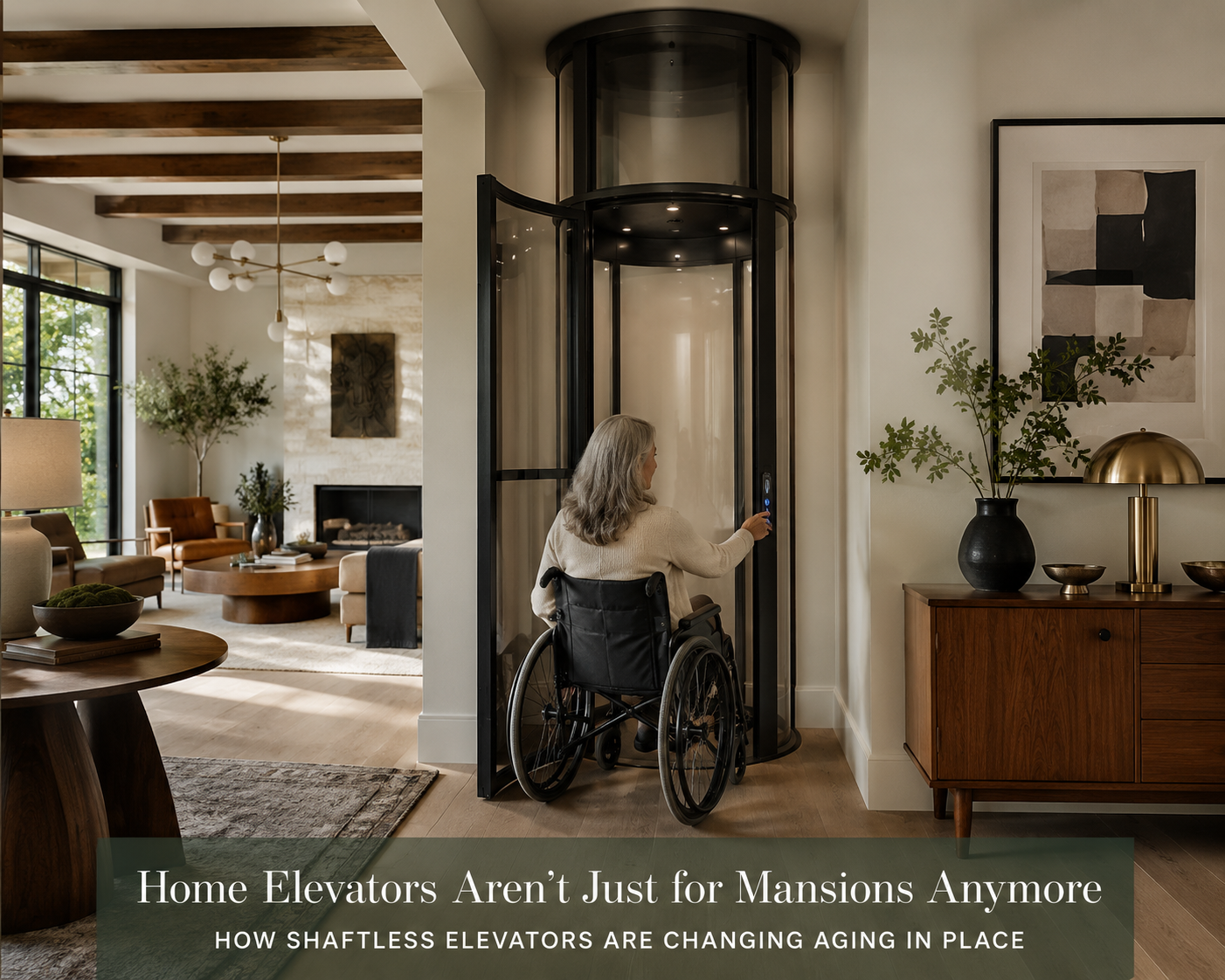
Home Elevators Aren't Just for Mansions Anymore: How Shaftless Elevators Are Changing Aging in Place
For decades, a home elevator meant one thing: a sprawling estate with the budget and square footage to spare for a full shaft, a machine room, and months of construction. If you needed help getting between floors and didn't have that kind of space or budget, your only real option was a stair lift a motorized chair bolted onto a track that ran up your staircase.
Stair lifts did their job, but nobody loved looking at them. The exposed rail running the length of a staircase became a permanent visual reminder of a mobility need, sitting in the middle of a home's most visible architectural feature. For families trying to age in place gracefully, or make a home usable for a loved one in a wheelchair, that trade off function over beauty felt like the only choice available.
That's no longer true. Shaftless home elevators have quietly become one of the most practical accessibility upgrades available to ordinary homeowners, not just mansion owners, and they solve the stair lift's biggest problem: they don't have to look like medical equipment bolted onto your home.
What makes a shaftless elevator different
A traditional elevator needs a hoist way (the shaft itself), a pit dug into the floor below, and often a separate machine room. That's a lot of construction, a lot of cost, and a lot of disruption to an existing home.
A shaftless elevator skips nearly all of that. These are self supporting, pre engineered units that arrive from the manufacturer in modular sections and get assembled on site, one section stacked on top of the next, rather than built into a hole in your house. Most models plug into a standard 220–240V outlet, similar to a large appliance, and connect to two floors through a single opening rather than a full shaft.
Because there's no pit and no machine room, construction is minimal: an electrical circuit gets installed, an opening is cut between the two floors, and the unit is anchored to the structure above. Many companies complete installation in just a few days rather than the weeks or months a traditional elevator retrofit requires.
The result is a compact, self contained lift that can tuck into a corner, a closet sized footprint, or an open stairwell nook and one that can be removed later with far less repair work than a full elevator shaft would require, which matters if you're thinking about resale down the road.
Larger shaftless models are specifically designed to accommodate a wheelchair and, in many cases, a second passenger or caregiver riding alongside. When you're speccing one out for wheelchair use, a few details matter more than they might for an able bodied user:
- Low-mounted controls so buttons are reachable from a seated position
- Wide door openings and a roomy interior for turning radius
- Push-and-hold operation, which is standard on shaftless models and adds a layer of safety
- Battery backup, so the lift still works during a power outage a real concern if the elevator is someone's only way to reach a bedroom or bathroom
What the construction actually looks like
If you're picturing a construction crew ripping out floors for weeks, the reality is much less invasive. A typical shaftless elevator installation looks like this:
1. Site assessment — the installer confirms electrical capacity, ceiling height, and floor layout match the manufacturer's specs
2. Floor opening — a precisely sized opening is cut between the two floors, usually following a template the manufacturer provides
3. Rail and tower installation — the main support rail or lift tower is installed first
4. Cab assembly — the elevator cab is built in place and connected to the drive system
5. Testing and inspection — the unit is tested, adjusted, and inspected before it's cleared for regular use
Most installations take somewhere between two and five days depending on the model, a fraction of the time a full elevator retrofit would take.
Companies to Know
Home Elevator of Houston — installer specializing in shaftless vacuum elevators
Stiltz — known for compact, plug-in style dual-rail lifts
Cambridge Elevating — North American manufacturer with a strong reputation for aging-in-place installations
PVE (Pneumatic Vacuum Elevators) — makers of the distinctive cylindrical vacuum elevators, manufactured in the US
Nationwide Lifts and Lifeway Mobility — larger providers with wide service networks
Inclinator Company of America — one of the longest-running names in residential elevators
Have questions about designing an aging-in-place home around a shaftless elevator? [Book a consultation](https://www.independencebydesignstudio.com/contact) and let's talk through what would work for your space.