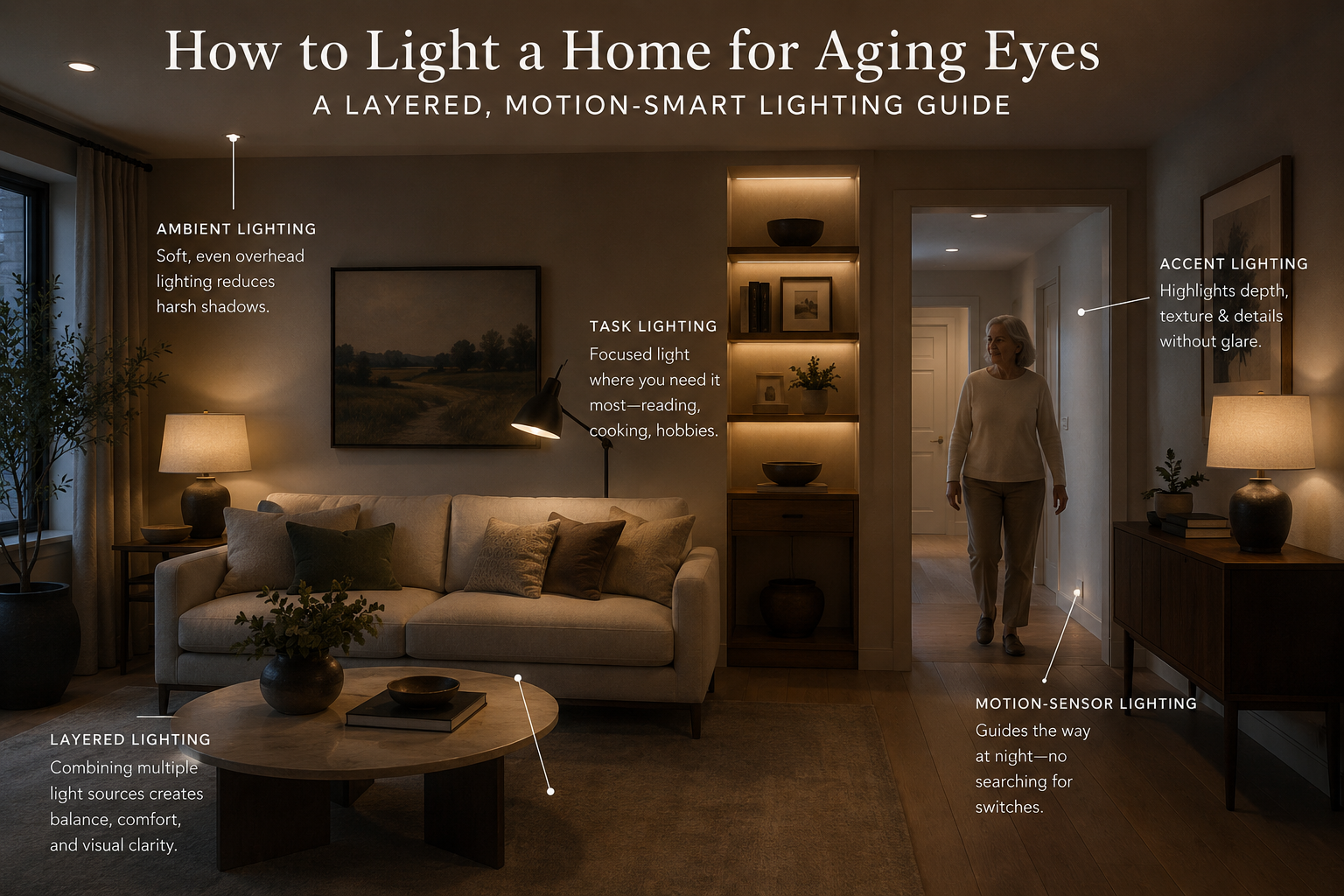
How to Light a Home for Aging Eyes: A Layered, Motion Smart Lighting Guide
Why aging eyes need so much more light
This isn't about preference it's biology. As the eye ages, the pupil shrinks and the lens yellows and stiffens, all of which reduce the amount of light reaching the retina. By the time someone reaches their 60s, they typically need two to three times more light than they did in their 20s to see the same details with the same clarity. Aging eyes also adapt more slowly when moving between light and dark spaces, which is part of why a dim hallway or an unlit staircase becomes a real fall risk, not just an inconvenience.
At the same time, aging eyes become more sensitive to glare, not less. So the goal isn't just "brighter" it's brighter, evener, and better controlled.
The layered lighting approach
Professional lighting designers talk about layering light rather than relying on one fixture to do everything and this matters even more for aging eyes, since a single overhead source creates harsh shadows that older eyes struggle to interpret.
1. Ambient (general) lighting — the base layer that fills a room evenly. Recessed lighting, flush mount ceiling fixtures, or wall washing fixtures work well here. Avoid single-source overhead lighting in kitchens and bathrooms especially, since it casts shadows directly onto the counter or sink where precision matters most.
2. Task lighting — focused light exactly where an activity happens: under-cabinet lighting in kitchens, a bright adjustable lamp by a reading chair, vanity lighting on both sides of a bathroom mirror (not just above it, which causes shadowing under the eyes and chin).
3. Accent and wayfinding lighting — subtle lighting that highlights transitions: stair-edge LED strips, baseboard lighting in hallways, illuminated house numbers. This is less about brightness and more about contrast helping the eye register "this is where the floor changes" before a foot does.
4. Night and motion lighting — low-level, motion-activated lighting for hallways, bathrooms, and bedside paths. This is arguably the single highest-impact, lowest-cost change you can make, since nighttime bathroom trips are one of the most common fall scenarios for older adults.
Room-by-room fixture recommendations
Hallways and staircases
Motion-activated LED step lights or stair edge strip lighting
Motion-sensor hallway night lights, warm-toned (2700K) so they don't disrupt sleep
Bathrooms
Vertical vanity sconces on either side of the mirror, not just above it
A motion-sensor night light near the toilet, low lux, warm tone
High-CRI, moisture-rated ceiling fixture for general lighting
Kitchens
Under-cabinet LED task lighting along the full counter run
Bright, high-CRI overhead lighting layered with pendant or recessed ambient light
Living and reading areas
Adjustable floor or table lamps near seating, positioned to avoid glare on TV or reading material
Dimmable ambient lighting so evening light levels can shift gently rather than abruptly
Bedrooms
Bedside lamps with large, easy-to-reach switches (or smart bulbs controlled by voice or app)
A soft, motion activated path light from bed to bathroom
A few finishing details that matter more than people expect
Avoid glossy floors and countertops wherever possible they reflect glare in ways that genuinely disorient aging eyes, especially at night.
Add dimmers everywhere you can. Aging eyes adjust slowly between light levels, so a dimmer that lets someone ease from bright daytime light to dim evening light is more comfortable than a hard on/off switch.
Keep switches large, illuminated, and at a consistent height throughout the home, so finding them doesn't require good lighting in the first place.
Use smart bulbs or smart switches where rewiring isn't practical many can be scheduled or voice-controlled, which sidesteps the "can't find the switch in the dark" problem entirely.
Beautiful furniture means very little without the right lighting.
Lighting influences how colors appear, how large a room feels, and even how comfortable people feel inside a space. Layering ambient, task, and accent lighting creates depth while highlighting architectural details and decorative features.
Natural light remains one of the most valuable design elements.
Large windows, reflective surfaces, and carefully placed fixtures can transform an ordinary room into something extraordinary.
The best interiors don't simply look beautiful they feel welcoming from the moment you walk inside.
Thoughtfully planned lighting brings every design decision together.